
Guide
How Flexible Packaging Recycling Works in Canada
Pouches, bags, wrappers and film are not recycled the same way as a bottle or a can. This guide explains how collection works in Canada, why flexible packaging is handled separately, and what brands should put on pack.
Three ways packaging gets collected
Residential recycling in Canada is organized province by province, and often municipality by municipality. Packaging usually reaches a recycler in one of three ways:
Curbside and multi-family
Bins or carts collected from homes and apartment buildings. Many curbside programs are built around containers and paper, and flexible film is often not included, or only in some communities.
Depots
Drop-off sites run by a program or a municipality. Depots can take materials that curbside collection does not, including flexible plastics in some programs.
Retail drop-off
Collection points at participating stores. Some programs take clean, dry plastic bags and film. The rules are set by each program and can differ from curbside rules.
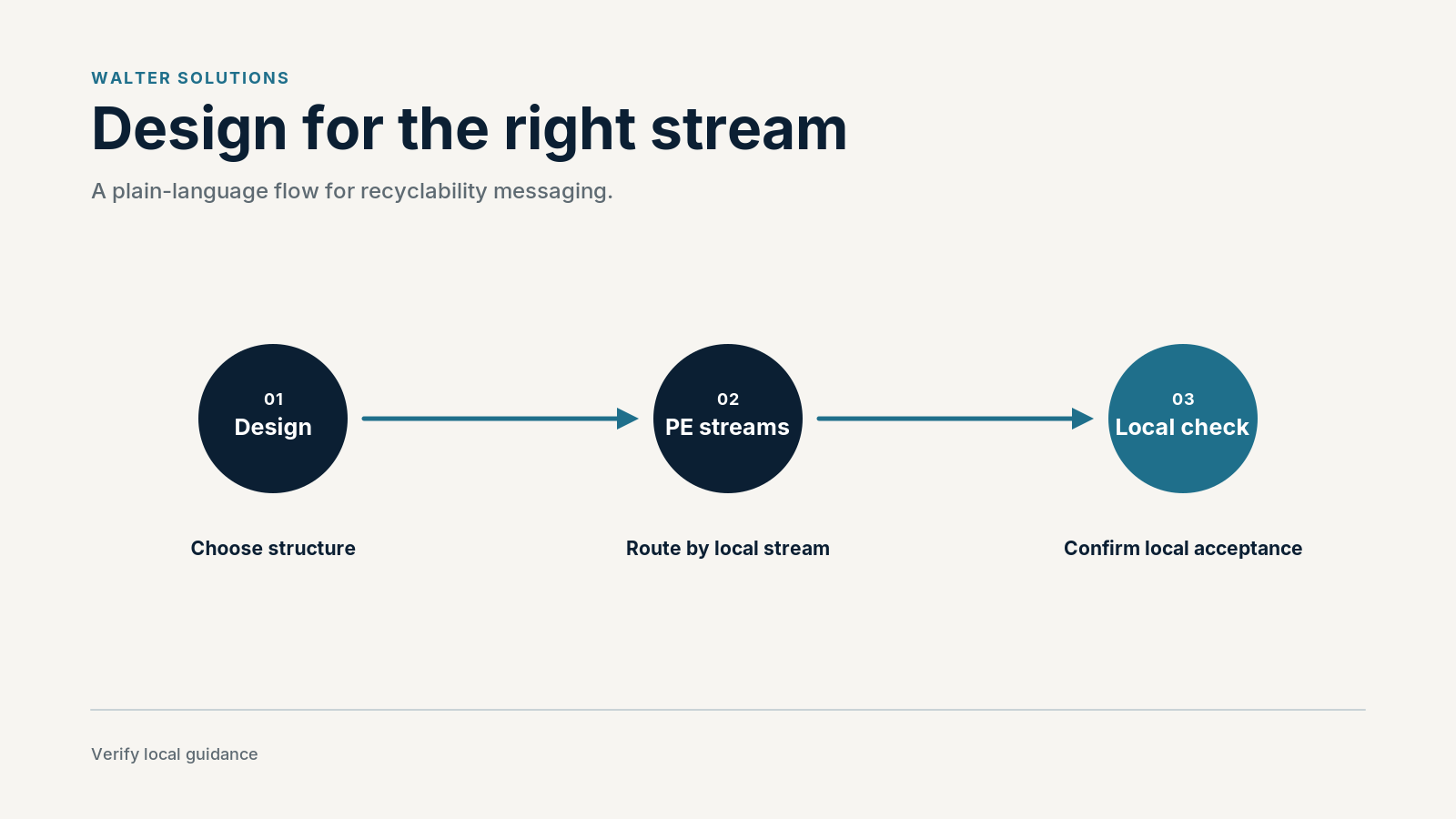
Which option applies depends on where the consumer lives. The same pouch can be collected at a depot in one place and not collected at all somewhere else.
Why flexible film is different
Sorting equipment in many recycling facilities is designed mainly to identify containers and paper. Thin, light film behaves differently: it can contaminate paper and container streams and get caught in machinery built for other materials. That is why many programs keep flexible plastics separate, or collect them only at depots.
Material matters too. Film made from one plastic family is easier to reprocess than a laminate that bonds different plastics, foil or paper together. A pouch that combines paper and plastic, or several different plastics, can be difficult to recycle even where flexible plastics are collected.
That is the reason for mono-material design. A pouch built predominantly from polyethylene can be designed for PE recycling streams. See mono-material PE stand-up pouches and our packaging solutions.
Example: Recycle BC in British Columbia
In British Columbia, residential packaging and paper recycling is run by Recycle BC under an extended producer responsibility (EPR) model: the businesses that supply packaging and paper to BC residents fund and manage the program (Recycle BC FAQ).
According to Recycle BC, flexible plastics are taken to a depot unless the community offers flexible plastics collection at home. Recycle BC reports that home collection is available in select communities, and that small quantities can also be dropped off at participating London Drugs stores (Recycle BC flexible plastics).
Recycle BC’s accepted list for flexible plastics includes items such as stand-up and zipper-lock pouches, crinkly wrappers and bags. Its not-accepted list includes packaging labelled biodegradable, compostable or oxo-degradable, and plastic-lined paper or paper-lined plastic.
Program lists change, and other provinces run their own programs with their own rules. Check the current Recycle BC guidance, or the program where your product is sold, before relying on it for on-pack wording.
How2Recycle and other on-pack labels
How2Recycle is an on-pack labelling program used in the North American market, in both the United States and Canada. According to How2Recycle, every label is backed by a custom recyclability assessment, and its labelling in Canada is based on Competition Bureau Canada guidance (How2Recycle).
A label like this is issued for a finished package, not for a film on its own. Walter Solutions does not hold or issue How2Recycle labels. If you want one, your finished package needs its own assessment through the program; we can share the structure and component information you will need.
The same thinking applies to any recycling symbol. A symbol on pack is a claim, and it should reflect how the finished package is actually collected where it is sold.
What brands should put on pack
Canada’s Competition Act requires claims about the environmental benefits of a product to be based on adequate and proper testing, and the Competition Bureau has published guidelines on environmental claims (Competition Bureau). For flexible packaging, that points to specific, qualified language.
Wording to consider
- Designed for recycling
- Designed for PE recycling streams
- Recycle where facilities and programs exist
- Local acceptance may vary; check locally
- Empty before recycling
Wording to avoid
- “100% recyclable”
- “Recyclable everywhere”
- A recycling symbol with no qualification
- “Compostable” and “recyclable” on the same pouch
- Vague terms such as “eco-friendly” or “green”
Before you print, review four things together: the film structure, the components (zipper, valve, spout, label, window), the exact sentence you want on pack, and the provinces and retailers where the product will be sold. Your legal and regulatory review should sign off on the final wording. Our recyclability language page lists the phrases we use and avoid.
Designing a pouch for PE recycling streams
- Keep the structure predominantly polyethylene, with a thin barrier layer instead of foil or PET
- Choose zippers and spouts from the same plastic family where possible
- Avoid paper labels and paper-plastic combinations on a PE pouch
- Review valves separately, since they are made from their own materials (see coffee bags)
- Use only as much ink coverage and window as the design needs
- Tell consumers to empty the pack; clean, empty film is easier to handle
Industry pages with more detail: pet food, snacks, nuts and dried fruit, frozen food and coffee.
Flexible packaging recycling FAQ
Are pouches accepted in curbside recycling in Canada?
It depends on where you live. Many curbside programs do not collect flexible packaging, while some programs collect it at depots, at home in selected communities or through retail drop-off. Check the local program for the finished package.
What does “designed for recycling” mean?
It means the package was developed with material compatibility in mind, for example a structure made predominantly from polyethylene for PE recycling streams. It does not guarantee that every local program accepts it.
Does Recycle BC accept stand-up pouches?
Recycle BC’s flexible plastics list includes stand-up and zipper-lock pouches, collected at depots, or at home in communities that offer flexible plastics collection. It excludes packaging labelled compostable or biodegradable and plastic-paper combinations. Check recyclebc.ca for the current rules.
Can we put a How2Recycle label on our pouch?
How2Recycle labels are issued per package after the program’s own recyclability assessment. Walter Solutions does not issue these labels; contact How2Recycle about membership and an assessment of your finished package.
Can a compostable pouch go in with flexible plastics?
Generally not. Recycle BC, for example, does not accept packaging labelled biodegradable, compostable or oxo-degradable in its flexible plastics stream. Composting and PE recycling are different end-of-life paths.
How can Walter Solutions help?
We review your current pouch, recommend a PE-based structure designed for PE recycling streams, supply samples and help you plan conservative on-pack wording. Start with a packaging assessment.
Plan a pouch designed for recycling
Request a packaging assessment or samples to start the evaluation.
Recyclability notice
Recycling acceptance and collection methods vary by province, municipality and recycling program. A package described as “designed for recycling” has been developed with material compatibility in mind but may not be accepted in every local collection system.